
Cauldron
Instrumentation: Orchestra (3232 4231, pno, harp, timp, 3 perc, strings)
Year Composed: 1995
Duration: 7 minutes
Pages in score: 38
Cost: Rental: $80.00; Purchase: $200.00
Play Cauldron from a live performance by the New York Youth Symphony, Miguel Harth-Bedoya, conducting
Recording:
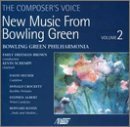
This piece can be heard on the CD
New Music from Bowling Green, Vol. 2 (performed by the Bowling Green Philharmonia, Emily Freeman Brown, conductor
Representative Performances:
| Greater Miami Youth Symphony, Huifang Chen, conductor (2011) Asheville Summer Community Orchestra, Earl Hefley, conductor, Asheville, North Carolina (2003) New England Philharmonic, Boston, MA (2001) Crane Symphony Orchestra, Potsdam, New York (1997) Eugene Symphony, Miguel Harth-Bedoya, conductor (1997) Bowling Green Philharmonia, Christopher Hisey, conductor (1996) |
Review:
Performance by the Eugene Symphony, Miguel Harth-Bedoya, conductor, reviewed in the Register-Guard (Eugene, OR) by Michael Souther on 5/29/97: "'Cauldron' is an exciting, dynamic tour-de-force, with a relentless ostinato, here taken up by the piano, then the harp, then migrating around the ensemble, never completely disappearing...All sections of the orchestra got to shine in turn, and the playing left one full of admiration both for the musicians and for the young composer of this fine work."
Percussion Required: 4 tomtoms, 2 timbales, snare drum, bass drum, triangle, 3 suspended cymbals, xylophone, vibraphone, crotales [one octave]
Program Notes:
Cauldron was commissioned and premiered by the New York Youth Symphony. Because it
was written for a youth symphony, I wanted the piece to be lively, rhythmic and upbeat, as
well as something that would be enjoyable to perform. On the other hand, I think there is a
dark quality to this piece (something that is found in most of my music), a darkness which for
me the title connotes.
A near-continuous eighth-note ostinato is the main thread running through the piece, providing a backdrop over which the rest of the music is heard. Ostinati are common in my music, and I often think of them as a metaphor for the unchanging, uncaring universe over which time, history and our lives play out. Even though this ostinato affects and is affected by the foreground music, I feel the metaphor holds true in this piece as well. Despite that, this is not a programmatic piece; if anything it has neo-classical sensibilities.
Formally, the piece divides into three sections which could be labeled A-B-A', although the second A section spends a substantial amount of time exploring a new area. The outer sections are generally more active and louder than the central section (although both A sections begin softly), and focus on fragments of melody and short threefold repetitions of chords. In contrast, the middle part of the piece features longer legato lines played by solo wind instruments. Eventually, though, these lines are also fragmented and slowly piled up on each other in a gradually crescendo of activity.
Although this piece has strong tone centers, it is not traditionally tonal like 18th- and 19th-century music. In the outer sections, the repetitive eighth-notes center around G; in the middle section it is E that is the primary pitch. Only once does the eighth-note pulse stop, and that is during the transition from the B section to the return of A. Near the end of the piece, however, the ostinato transforms, and instead of pitched eighth-notes, it becomes sixteenth-notes played by drums.